Michele Regenold, Writing for Kids from the Boondocks

A blog about writing for children and the quest for publication.

Saturday, September 30, 2006

Back to writing school follow-up

About a dozen Ames and Des Moines area members of SCBWI gathered today to hear panel members talk about their experiences as students and teachers of writing. Audience members shared some of their own experiences too.

Cindy Johnson talked about taking one of the Institute for Children's Literature courses in writing for children. She said the materials alone were worth the tuition. Sharelle Byars Moranville, a part-time ICL instructor, agreed. You don't have to be an ICL student to receive their free email newsletter or use their online chat.

SCBWI members who are interested in ICL may also want to visit the SCBWI discussion board and do a search on ICL. There have been several discussions about it, and I think the current pricing was mentioned too. The price for the course isn't easily discerned from their materials.

Kay Smith talked about her experiences with weekend and week-long writing courses at the Iowa Summer Writing Festival. Kay has found these courses really useful. All students are welcome. No need to qualify for admission except by your willingness to learn.

Kay took a week-long course this summer, Scene By Scene: Building A Middle-Grade/Young Adult Novel, taught by Sharelle. Kay said she came away with so much to work with from that course that she may not take a course next summer. Sharelle said she'll be taking next summer off from teaching at Iowa too.

Prices for the weekend courses run about $225 and week-long courses are $475-500. The fee doesn't include housing but some meals. The courses are non-credit.

I talked about the MFA in writing for children and young adults at Vermont College. Next year the program will be 10 years old. I've written quite a bit about my experiences in the program on this blog, so I won't summarize them here. Attending VC is an expensive venture, about $6,500 per semester (4 semesters total), including food and dorm. But for those with the time, the energy, and the willingness to go into student loan debt, it is undoubtedly one of the best investments you can make in yourself as a writer.

A new low-residency MFA for children's writers is starting up at Hamline University in St. Paul, Minnesota in January. Several former VC faculty have headed to Hamline, so I'm sure the programs will be similar. The big difference for the first few semesters at Hamline is that they won't have the upperclassmen there to help show the underclassmen the ropes. The community of writers, both the faculty and the students, is one of the great things about VC. Hamline will surely get there eventually.

Sunday, September 24, 2006

When to submit to an editor

As writers, how do we know when our work is ready to submit to an editor? Another way to think of that question is how do we know when our work is really publishable?

It's frustrating when we see books published that aren't particularly well written. Some of the "celebrity" written books, for example. If XYZ can get published, we think, why don't they want my manuscript?

Last winter, shortly before I started the Vermont College MFA in children's writing program, I sent a revised MG fantasy novel to Debbie Vetter at Cricket Books. At the time, I thought that novel was as good as I could make it, that it was as good or better than plenty of other fantasies that have been published. (Yes, my head swells to immense proportions sometimes.)

About four months into my first semester, I started to expect a response from Ms. Vetter. (She'd read this whole novel a couple of years earlier and sent a lovely detailed rejection letter.)

During that first semester I learned so much about the craft of writing. It would have taken me five years on my own to fumble my way to that level of knowledge.

I started to think that maybe it would be better if Ms. Vetter would reject my novel again. I was worried that if it got published too soon, I'd be embarrassed by it later.

Well, no problem there. A few days later, Ms. Vetter sent the manuscript back with another lovely rejection letter, this one stating quite plainly that she didn't want to see the novel again, along with comments on the manuscript.

I filed that novel away. I can't write that one as well as I want to yet, but someday I'll go back to it.

So how do we know when to submit? I've been guilty of submitting pieces way before they're ready. I suspect many writers are. Time away from the piece always clears up my rose-colored glasses and helps restore a bit of objectivity.

Since I started the Vermont College program, I haven't submitted anything to publishers or agents except for a critique at Iowa's SCBWI conference this fall. I submitted the first chapter of my YA mystery. I've revised it about five or six times, three times since being a student at VC. I don't have a first draft of the whole novel yet, but I'm about three-quarters done and know where it's going. I view this critique as a way to get an editor's or agent's perspective on what's working and what's not. I'll let you know what I find out.

Saturday, September 02, 2006

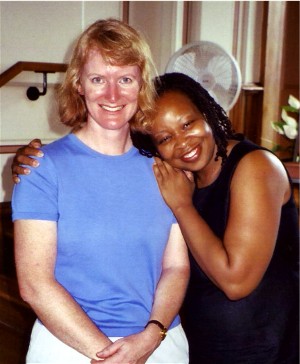
Rita and me

Rita Williams-Garcia, my first-semester adviser, posed with me after the July graduation ceremony at Vermont College. It was rather warm, which is all I can say about why my face is so red. (Photo by Margaret Nevinski, my classmate and roommate.)